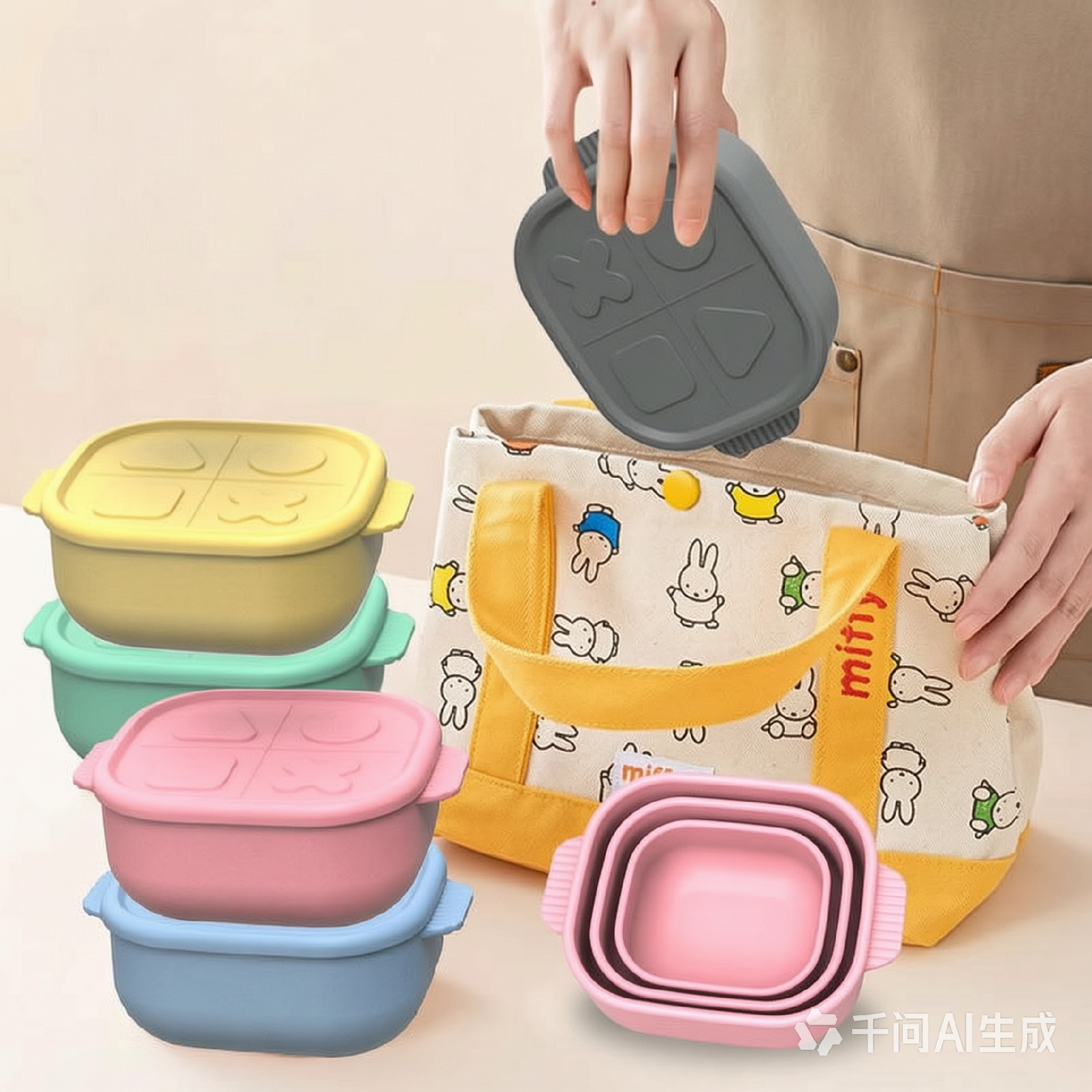
Silicone Fridge and Freezer Storage Containers: Specifying for Meal-Prep Retail
Read:7
Silicone storage containers have moved from novelty to a staple of the meal-prep aisle, because they solve the two failures that kill plastic containers: cracking at freezer temperatures and staining with tomato or turmeric. The buying conclusion for importers is that the category is won or lost on set architecture — sizes that nest, lids that stack, and one gasket system across the range. Get the set logic right at the specification stage and the rest of the programme follows.
Why silicone is taking shelf space in food storage
Polypropylene and glass dominate food storage, and each leaves a gap silicone fills. Glass is premium and stain-proof but heavy, breakable in transit and unusable straight from the freezer in a hot oven. PP is light and cheap but stains, holds odour, and becomes brittle through repeated freeze-thaw cycles. Silicone sits in the middle: light like plastic, inert like glass, flexible at freezer temperatures, and stable above boiling point for oven reheating. For retailers the pitch is a single container that freezes, microwaves, bakes and survives the dishwasher for years — a durability story that justifies a mid-premium price point between PP and glass.
The honest caveat to manage: soft silicone walls flex, so these containers are for storage and reheating, not for stacking heavy items in a loaded freezer like rigid boxes. Specify wall thickness and base geometry so the shape holds under a modest load.
Size systems and nesting logic
A coherent size ladder is the single most important design decision. Successful meal-prep sets converge on a small number of rectangular volumes that nest inside each other and share one lid family:
| Container | Usual capacity | Primary use | Notes |
|---|---|---|---|
| Small square | 350–500 ml | Sauces, berries, snacks | Base of most starter sets |
| Medium rectangle | 800–1,000 ml | Single meal prep portion | The workhorse SKU of the category |
| Large rectangle | 1,400–1,800 ml | Family portions, batch cooking | Check freezer shelf depth fit |
| Deep tall | 1,200–1,600 ml | Soups, stews, liquids | Needs the most robust gasket |
Rectangles fit fridge shelves and bento-style bags better than rounds, which is why the market has standardised on rectangular bodies. When briefing the factory, provide the nesting clearances you want between sizes and the minimum collapsed wall thickness; both determine how the tool cavities are laid out and how many cavities a mould can carry.
Lids, gaskets and the stacking question
Lid design determines whether the set feels premium or loose after a month of use. Three constructions are common: a plain press-fit silicone lid (simplest, fine for fridge storage but not leak-secure), a lid with a moulded-in gasket flange that locks under the rim (the current best-practice for leak-secure claims), and a rigid frame lid with a silicone gasket (stacks well and protects soft bodies, but adds assembly). For meal-prep retail, the moulded-flange lid is the default recommendation: it is leak-secure, dishwasher safe, and carries no separate parts to lose.
Stacking needs an honest test protocol. Soft bodies compress under stacked weight; if your packaging shows stacked containers, the lids you photograph must support the claim. Specify a minimum lid rigidity or add a thin PP reinforcement ring where stacking display matters.
Freezer-to-oven claims you can defend
The marketing headline of this category is "one container from freezer to oven". Silicone's material properties support the claim — flexible below −40 °C and stable to about 200–230 °C for continuous exposure — but the container design must let you make it honestly. Straight-sided thick bases heat slowly; some designs specify a maximum filled weight for oven use; and lids are usually not oven-rated, so the packaging must say "lid off". Ask the factory for the compound's temperature-ageing data and write the packaging claim from that data rather than from a generic category claim.
Food-contact compliance for coloured compounds
Because containers touch food across a wide temperature range, migration testing matters more here than in most silicone categories. Specify FDA 21 CFR 177.2600 or LFGB-based requirements for the US and EU respectively, and require the report for the exact coloured compound — strong reds and oranges are the pigments most often associated with migration issues in low-cost grades. Platinum curing is the industry-standard answer for premium food storage: lower volatile content, better colour clarity for pastel ranges, and no white peroxide bloom that prompts early customer complaints.
Set structure, packaging and retail economics
Retail sets of three or five containers with matching lids dominate sell-through, because the buyer can visualise a week of meal prep. Flat-packed or nested packaging cuts freight meaningfully: nested sets ship at a fraction of the carton volume of rigid equivalents, and silicone's low weight keeps air-freight quotes survivable for launches. Printed retail cartons with window cut-outs are standard; confirm the carton compression strength for palletised shipping rather than treating packaging as an afterthought.
Industry-typical practice for a custom set programme is new tooling plus samples in roughly two to three weeks and mass production three to five weeks after approval, with MOQs commonly starting around 1,000–2,000 sets per colourway. Treat these as ranges to confirm in writing, not commitments.
What to put in the RFQ
- The size ladder with nesting clearances and which sizes share lids.
- Lid construction preference and whether lids must pass a leak test with liquids.
- Target markets and required food-contact standards for the coloured compound.
- Temperature claims you intend to print, so the compound and testing match them.
- Set contents, carton style, window requirements and pallet configuration.
- Logo process on bodies and lids, with artwork attached.
- Test list: leak method, freeze-thaw cycles, dishwasher cycles, oven-use conditions.
FAQ
Are silicone containers safe for the freezer?
Yes. Silicone remains flexible well below household freezer temperatures and does not become brittle or crack the way rigid plastics can. Ensure lids are designed to seal at low temperature, since gasket contact pressure changes slightly when everything contracts.
Do they stain with tomato sauce or turmeric?
Platinum-cured silicone resists staining far better than PP; heavily pigmented curries can still leave a temporary tint on cheaper, filler-heavy compounds. Ask for stain-resistance data or run a 7-day sauce contact test on the exact compound before approving packaging claims.
Can I put the whole set in the dishwasher?
Bodies and moulded-flange lids are dishwasher safe; rigid-frame lids with PP rings should be checked for top-rack rating. Specify a dishwasher cycle count in the test plan — 50 cycles is a common verification benchmark for retail claims.
What set sizes sell best?
Three-piece sets built around a small, medium and large rectangle are the category workhorse; five-piece sets suit gift and premium slots. Confirm your market's shelf depth before fixing the largest container's footprint.
Next step
Send your size ladder and set structure for a manufacturability review and quotation, browse reference items under silicone kitchen products or the full product catalogue, and see how our OEM and ODM service covers tooling, colour and documentation in one place.