Silicone Skins and Bumpers for Compact Cameras and Kids' Cameras: Fit, Tolerance and Colour
Read:5
A silicone skin is a low-cost accessory attached to a device with tolerances the moulder does not control, and that asymmetry is the entire engineering problem. The buying conclusion is that fit is decided by three dimensions — the lens aperture, the button pad geometry and the wall thickness over the corners — and that all three must be derived from the device's actual production drawings rather than from a retail sample. Get those right and the skin becomes a repeat-purchase accessory; get them wrong and it is a one-star review about a case that will not stay on.
The device is the specification
Skins are usually developed against a competitor's product, which is normal and workable, but the developer must know how much the device itself varies. Consumer electronics mouldings commonly carry ±0.1–0.2 mm on external dimensions, and a skin designed to nominal will be tight on the upper end of that band and loose on the lower. The practical fix is to specify the skin's interference at the lower tolerance limit rather than at nominal: a skin that grips a slightly undersized device will also fit a nominal one, whereas the reverse produces a cover that slips off. Ask the brand for the device's tolerance band, and if it is unavailable, measure at least five units from different production lots.
Four dimensions that decide whether it fits
Most fit complaints trace to a small number of features, and each needs its own callout on the drawing:
| Feature | What goes wrong | Specification approach |
|---|---|---|
| Lens aperture | Skin intrudes into the image circle or vignetting appears | Aperture 0.3–0.5 mm larger than the lens bezel outer diameter; check at wide angle |
| Button pads | Mushy feel, or button actuates accidentally in a bag | Pad height set so actuation force rises 15–25 % versus bare device |
| Corner wall thickness | Thins during moulding, tears at drop | Minimum 1.2 mm at corners; do not rely on nominal wall |
| Port and strap cut-outs | Charging cable will not seat; strap will not thread | Cut-outs sized to the plug overmould, not the metal connector |
| Inner ribs | Skin rotates or slides off the body | Two or three localised ribs, not a continuous inner liner |
The button pad is the specification most often left as "make it feel right". It should be quantified: ask for a force-deflection curve on the assembled unit, and compare it with the bare device. A pad that adds more than about a quarter to the actuation force reads as unresponsive; a pad that adds nothing provides no protection and will be pressed by bag contents.
Material choice: silicone versus TPE
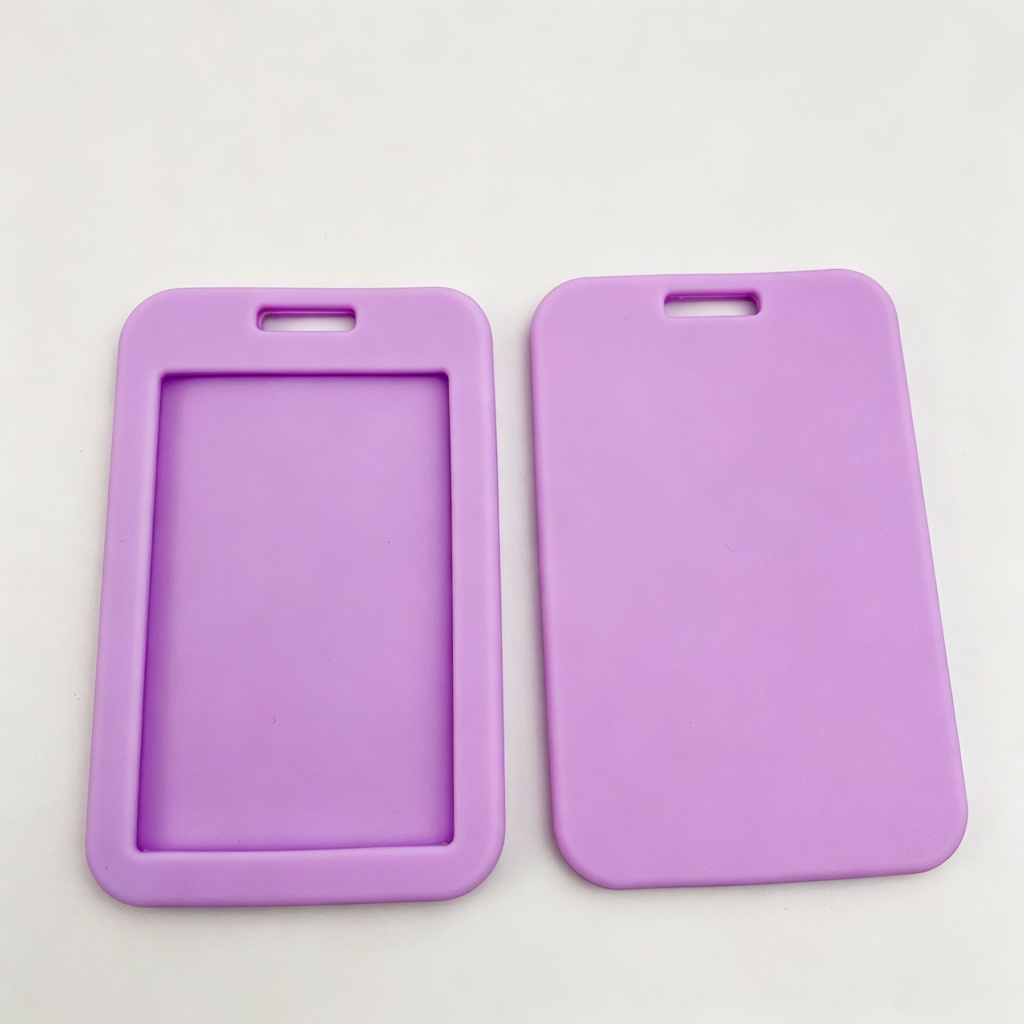
Silicone offers better heat resistance, better colour stability and a drier, less grippy feel; TPE offers lower cost and easier overmoulding onto rigid substrates. For camera skins the decisive factor is usually colour fastness, because these products are bought on colour — pastel ranges for kids' cameras, saturated tones for action cameras. Silicone holds pigment without the surface migration that makes TPE skins look greasy after a season of handling. Hardness in the 50–60 Shore A band balances grip and tear resistance; softer compounds feel premium but tear at the port cut-outs.
Drop protection: what a skin can honestly claim
A 1.5 mm silicone skin absorbs impact energy and spreads the load, which genuinely helps against scuffs, corner strikes and short falls onto hard floors. It does not make a device waterproof, and it does not prevent screen breakage on a face-down drop. Retail claims should match that reality — protection against knocks and scratches, not drop ratings — because a claim of drop protection invites a liability conversation the moment a screen cracks. Where a programme targets children's cameras, the relevant standard is the toy-safety scope, not a phone-case drop test, and the two should not be conflated in marketing copy.
Colour programmes and tooling economics
Camera skins are almost always sold in colour ranges, which changes the cost model: the tool is amortised once, but each colour is a separate production run with its own minimum. A four-colour launch on a single tool is efficient; eight colours across two device generations starts to fragment volume. Practical guidance is to launch three or four colours, keep one neutral shade as the repeat line, and add seasonal colours on the same tool. Where the skin carries a printed logo or a debossed mark, confirm that the decoration survives the stretch applied during fitting — pad printing on a high-stretch area will craze.
Cost, tooling and MOQ
Skins are thin-wall compression or injection mouldings with modest tooling; unit cost is driven by silicone weight, cavity count and the number of colours run per cycle. Industry-typical practice is samples in two to three weeks (including a fit check on the actual device) and production three to five weeks after approval, with MOQs commonly starting around 1,000–2,000 pieces per colour. Where the device itself is still in development, plan for a second sampling round after the device's production tool is cut — this is normal and should be written into the schedule rather than discovered.
What to put in the RFQ
- Device model, production drawings and the external tolerance band.
- Lens bezel outer diameter and the widest angle the aperture must clear.
- Button locations with the target actuation-force increase.
- Port and strap cut-out dimensions, referenced to the plug overmould.
- Colourways and the number of device generations the tool must serve.
- Whether the skin ships assembled on a dummy device or flat in a polybag.
FAQ
Why does my silicone camera case keep slipping off?
Usually because the skin was designed to the device's nominal dimension, so it is loose on units at the lower end of the tolerance band. Specify interference at the lower limit and add localised inner ribs rather than a continuous liner.
Will a silicone skin protect a camera from drops?
It reduces scuffing and absorbs energy on corner impacts from low heights. It does not prevent screen damage from a face-down drop and does not provide water resistance. Claims should reflect that.
Can the same tool fit two device generations?
Only where the external dimensions and button positions are unchanged. Camera bodies typically change port layout and button placement between generations, which usually requires a tool modification rather than a new tool — cheaper, but it must be scheduled.
What MOQ applies to a custom camera skin?
Industry-typical MOQs start around 1,000–2,000 pieces per colour on a new tool. Running four colours at launch is common; adding colours later on the same tool keeps the unit economics workable.
Next step
Send your device drawings, lens diameter and colour plan for a fit review, or browse reference items under silicone 3C and digital accessories and the wider product catalogue. Children's camera accessories are covered under baby and kids products, and our custom OEM and ODM service handles tooling, fit sampling and colour matching in-house.