Soft Enamel vs PVC Drip vs Epoxy Resin: Choosing the Right Badge and Keychain Process
Read:9
Three processes dominate custom badges, keychains and fridge magnets — soft enamel metal, PVC drip moulding and epoxy resin coating — and listings make them look interchangeable. The buying conclusion: choose by artwork style and use environment first. Metal soft enamel wins fine-line and premium-metallic looks; PVC drip wins 3D relief, soft touch and phthalate-free compliance at volume; epoxy resin wins photographic and gradient artwork at the lowest cost. Matching artwork to process before quoting prevents the most common disappointment: a design that arrives looking nothing like the mock-up.
The three processes at a glance
| Factor | Soft enamel (metal) | PVC drip | Epoxy resin |
|---|---|---|---|
| Base material | Zinc alloy, brass, iron | Soft PVC, layered in mould cavities | Two-part epoxy poured into a metal or resin tray |
| Artwork style | Line-and-colour, metallic finishes | Solid colour areas with raised 3D relief | Gradients, photographic and full-colour prints under a dome |
| Colour count cost | Each colour adds a screening step | Each colour is a mould cavity layer | Full colour from one printed insert |
| Feel | Hard, cool, metallic | Soft, rubbery, tactile | Glass-smooth dome over flat art |
| Durability | Very hard; plating can wear | Flexible; resists drops; can deform under heat | Dome resists scratches; can yellow under UV if poorly formulated |
| Typical tooling | Die per design | Steel mould per design and size | Tray tool per shape |
| Compliance focus | Lead, cadmium, nickel release | Phthalates (REACH, CPSIA) | Cured hardness, VOC, UV stability |
Matching artwork to process
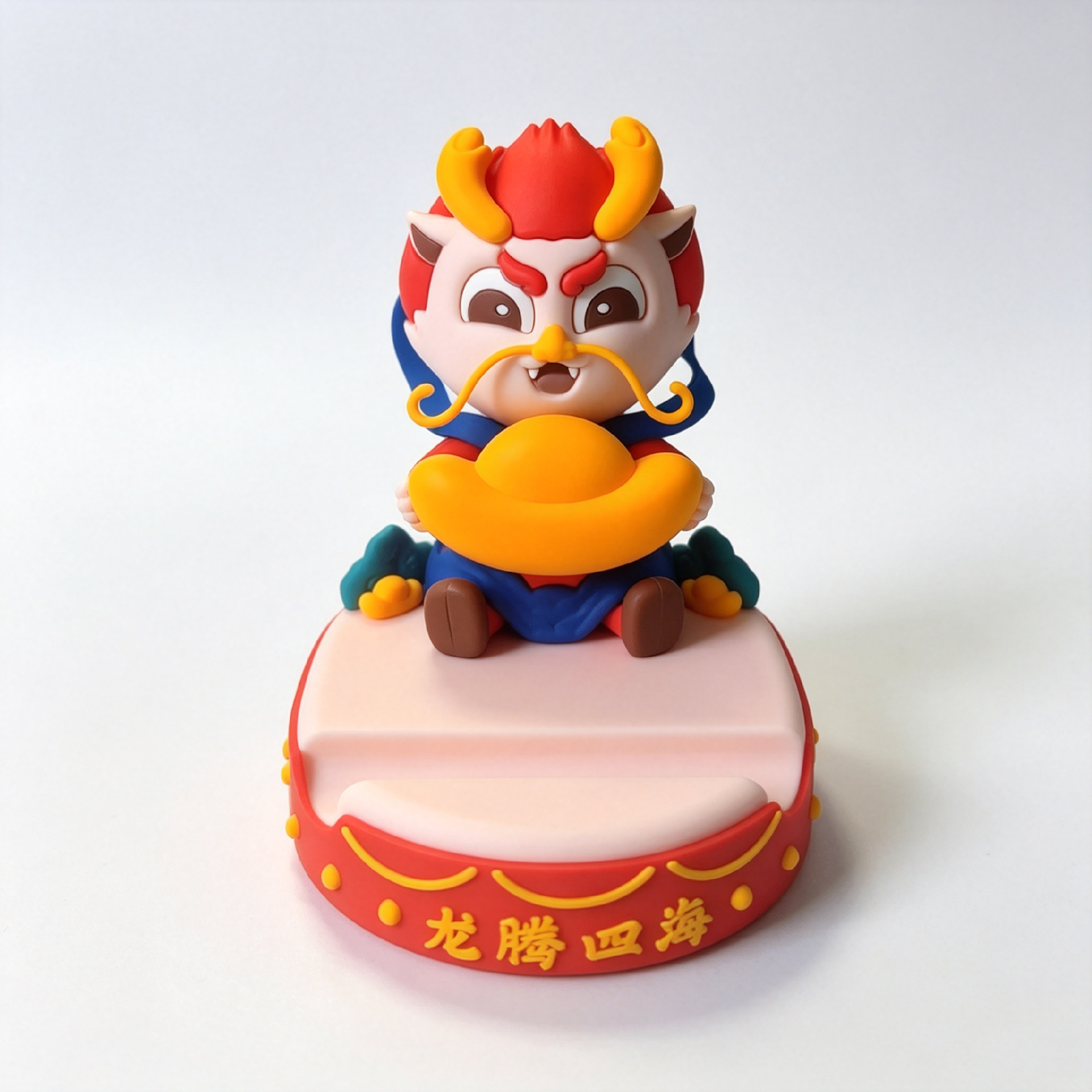
Artwork decides the outcome more than price does. Fine outlines, text smaller than about 1 mm, metallic gradients and gem settings are enamel territory — PVC cannot hold a hairline, and epoxy prints blur below roughly 0.8 mm strokes. Bold cartoon shapes, layered colour depth, chunky 3D lettering and two-tone camo effects are PVC strengths; the layered mould naturally creates the raised-and-recessed look that reads as "quality" at a promotion counter. Photographs, watercolour art, holographic patterns and unlimited colour counts belong to epoxy doming, where the printed insert carries the image and the resin is only the lens.
Send the same artwork to quotes in two candidate processes and ask for a digital mock-up plus a physical pre-production sample of the winner. Mock-ups rendered in one process but manufactured in another are a recurring dispute in this category.
Durability in real use
Keychains live in pockets with keys and coins, which is a scratch and flex test. Soft enamel holds shape excellently; its risk is plating wear on high-contact edges and enamel chipping on sharp internal corners. PVC flexes instead of denting, and its colour goes through the material, so abrasion never exposes a different substrate — the trade-off is deformation if left on a car dashboard in summer heat. Epoxy domes resist scratching well, but a formulation with poor UV stabilisers will yellow within a season of sunlight; demand UV-ageing data or a yellowing-resistant resin grade for outdoor-facing products like bag charms and luggage tags.
Compliance: the part that catches importers out
Each process carries its own regulatory centre of gravity. For metal enamel badges the classic issues are lead and cadmium in the alloy and plating, plus nickel release for items touching skin. PVC drip products are governed by phthalate limits — REACH in Europe restricts the phthalate list for articles, and CPSIA governs children's products in the United States — so specify phthalate-free plasticisers such as DOTP in writing and ask for test reports against your market's limits. Epoxy is generally benign once fully cured, but under-cured resin can carry unreacted components; confirm the curing schedule and request migration testing for items marketed toward children.
If the product appeals to children, treat the small-parts rule seriously regardless of process: any badge or charm that can fit the small-parts cylinder needs an age grading and warning text on packaging in the US, and equivalent toy-safety assessment in the EU.
Cost structure and where the money goes
Tooling: a PVC mould is priced per design and size and usually costs less than a metal die for the same artwork complexity; epoxy trays sit in between. Unit cost: enamel rises with colour count and plating choice; PVC rises with the number of colour layers and total drip steps; epoxy is nearly flat with colour count because the print carries it. For a 12-colour gradient design, epoxy is almost always the cheapest route to a faithful result; for a 4-colour bold emblem at 10,000 pieces, PVC drip typically wins on both cost and tactile appeal.
How to decide in one pass
- Classify the artwork: line-and-colour, bold relief, or photographic/full-colour.
- Fix the use environment: pocket wear, outdoor UV exposure, or controlled merchandising.
- Set the compliance frame: market, child appeal, skin contact.
- Quote the two surviving processes with tooling shown separately and samples ordered from the preferred one.
- Approve only against a physical pre-production sample, not a rendered image.
FAQ
Is PVC drip safe for keychains sold to children?
Phthalate-free, heavy-metal-controlled PVC compounds are widely used for children's accessories and can meet CPSIA and REACH requirements. The obligation sits with the specification: name the plasticiser system, demand the test report for the exact compound, and age-grade the product honestly.
Why does my epoxy keychain turn yellow?
Aromatic epoxy resins yellow under UV without stabilisers. Ask for a UV-stabilised or aliphatic topcoat formulation, and request accelerated UV ageing data before approving designs that will live on bags or car mirrors.
Can one factory really make all three?
Some vertically integrated factories run PVC drip lines and epoxy coating in-house and partner for metal die casting; others specialise. What matters is that the factory you contract with owns the process it quotes and does not quietly subcontract the compliance-critical step.
Which process is fastest for a tight launch?
Epoxy doming is usually fastest because the artwork is printed rather than moulded colour by colour; PVC drip follows; enamel with plating takes longest. Confirm sample and mass-production lead times separately, not as one number.
Next step
Send your artwork with target market and volume for a process recommendation and quotation. Our PVC and epoxy drip products line covers drip moulding and resin coating in-house, with examples across our product catalogue, and tooling through the custom OEM and ODM service.